
Ways to Move
reviews of all the movement styles I've tried and the lessons I learned

Moving seems so natural that it’s easy to forget how mind-bogglingly deep and subtle it is. The human body has hundreds of muscles, and we adjust the tension of each of them ten or more times per second. Imagine learning to control a marionette this complicated; it would be impossible using explicit conscious thought. And yet babies do it by instinctual experimentation, though it takes them many years to get to basic competence, and reaching the pinnacle of skill can be a life’s work. Now consider how many ways there are to move, not just every dance style but every manual skill, every gait and posture, every facial expression. Then multiply that by the number of human cultures: all cultures have not only a characteristic mindset but also a characteristic bodyset, a particular way of holding and moving oneself in space. If we look even closer at the subtleties, every family and every individual person has their own variation on their culture’s bodyset; we can often recognize people from a long ways off by the way they sit, stand, and move.
So at the very least, there are billions of ways to move, and for every movement style we can see in the world today, there are many more that were practiced by cultures and people who have died, and also those who have yet to be born, and also those that nobody will ever try. To say nothing of all the other animals on Earth, and even the plants and fungi, if we could slow ourselves down enough to catch them moving. Needless to say, I’ve only sampled a tiny slice of this vast space, but I thought it might be interesting to review all the different movement practices I’ve tried and what I’ve learned from them and then, at the end, get into some bigger philosophical ideas about what movement is good for.
Soccer
I think I started playing soccer around age eight, on a team with all my friends. Because of adults not getting along, we quickly moved out of the local county league and joined the one based in the state capitol, which meant we had to drive a lot for games but we also got to play against tougher competition. After a year or two of winning the annual tournament, we moved up to the “challenge” league, which prompted our coach to get a lot more serious and the game to get a lot less fun. Maybe this was my biggest lesson from team sports: I don’t really enjoy competition. I mostly played fullback, which meant I spent most of my time waiting for the other team to come my way, punctuated by sudden intense bursts of sprinting to engage and block them. I really enjoyed going fast, so when we went to high school I switched to…
Running
I ran long-distance track and cross-country in high school. Of course it was still a competition, but I learned I could make it about pushing my own limits rather than worrying about what other runners were doing. And I usually did score for my team in races1 by pushing my body as hard as I could. Running the mile at track meets, my mouth and throat would always become dry as cotton wool, my body would be starving for oxygen, and every single time, after crossing the finish line, I would puke up a fountain of orange Gatorade. Then I would feel amazing for the rest of the day. So I learned about the “runner’s high” waiting on the other side of pain, and I could reach it in training too, once I relaxed into the run. But when I went to a public boarding school for my junior and senior years, I lost all motivation to push my limits, and was happy to just enjoy being outside and moving. I wound up running with the girls and no longer scored in races (I didn’t score with the girls either, I was a late bloomer).
Stretching
In training for track and cross-country, we did a lot of stretching to warm up and cool down. I think the idea was to reduce the chance of injuries, which often prevented our runners from racing. A common injury was “shin splints,” sharp pains around the shins which had people putting their legs in buckets of ice water. I never got any injuries to speak of but I was skeptical of icing because it seemed to be fighting against what the body was trying to do. We were also told never to bounce in stretches, which I think was meant to keep people from overdoing it and straining something. I’ve since discovered that bouncing in an attuned way is far more effective than static holds, but instead of teaching us that attunement they taught us something that could be done safely without paying attention. I can see now that this is a theme in many modern exercise systems.
Biofeedback
When I was about 12, I started getting headaches. My mom, who had also had headaches, was worried about me and tried various things to fix it, like avoiding feeding me things from a long list of “trigger foods.” One of the things she tried was taking me to biofeedback lessons, where a guy smeared some electrodes with gel and put them on my scalp. A set of headphones would then play a tone that rose when the electrical resistance between the electrodes decreased and fell when it increased. This is essentially the same galvanic skin response sensor that might be used to detect stress in a polygraph exam, but with the instant feedback it becomes a quick way of learning how to relax, because you always know how you’re doing. I found that I could make the tone rise even by just wiggling my little finger. I got pretty good at conscious relaxation, and the therapist taught me some visualization exercises and gave me a cassette tape with thunderstorm sounds on one side and ocean sounds on the other.
Why am I including this in a piece about movement? Because I believe we make a lot of subtle movements that are practically invisible, like tensing the scalp, firming the jaw or the lips, or squeezing the internal organs. Or the muscles on both sides of a joint can be tensed, constantly fighting each other and locking the joint in one position. When we’re still this is hard to see, but if we try to move in a fluid way, that joint will appear noticeably stiff, and the tension can cause pain, inflammation, or other symptoms. Relaxation is a type of movement, or maybe anti-movement, that can resolve these kind of static tensions. However, I’ve found that the usefulness of conscious relaxation is limited, because for one thing it’s hard to do while devoting my attention to something else, and for another thing it often makes me less energetic, as if I have to choose between being tense and doing something or being relaxed and doing nothing. I now see that this is a false dilemma, but the practice of conscious relaxation seems to reinforce it.
Massage
In my mid 20s I started noticing a lot of congestion in my sinuses that led to painful sinus headaches. Antibiotics and painkillers didn’t help much, but one day I ran across a book called The Trigger Point Therapy Workbook by Clair Davies on Amazon and searched inside it for “sinuses.” He said many sinus problems could be caused by something called a “trigger point,” a tense knot of muscle, in the sternocleidomastoid muscles that run from behind the ear down to the sternum and collarbone area. I felt my own neck and sure enough, there was a tender knot on each side the size of a large grape, and squeezing them instantly caused my sinuses to drain. I clicked Buy, and that started a years-long quest to find and release all the trigger points in my body. Along the way I explored rolfing and acupressure, and ultimately decided that it’s probably not possible to do this with massage alone. One issue is that the musculoskeletal system is really complex, it’s not just muscles but also sheets of fascia connected in interwoven paths of tension from head to toe and all the twists and turns in between. It’s also a dynamic system that’s constantly adjusting itself. Releasing tension in one place will often shift it to somewhere less obvious, and habitual movement patterns tend to quickly undo most of the gains from massage. Trigger points are very obvious physical manifestations of tension, but ultimately that tension permeates the body and connects to emotions, thoughts, habits, and in fact every aspect of life. Patterns of tension that take years or decades to develop are not going to be resolved with a little squeezing.
That said, self-massage allowed me to fix a huge range of health problems without doctors or medicine, including psoriasis, which is not supposed to be curable. I also learned that I didn’t need to use force to release trigger points. In fact, from massaging other people I learned that I could find a trigger point, put my fingers on it, pay attention to the tension in that part of my body, imagine breathing through it, relax, and as if by magic the other person would relax too! I discovered that massage was not just a mechanical process but a way to communicate without words. This opened my mind to many other forms of energy work.
Breakdancing
In my early 30s I moved out of the woods and into the city. East Durham was an area in the early stages of gentrification, and quite different from anywhere I’d lived before. I was surrounded by people of many classes and cultures, and the vibe was more gritty and urban. I’d been interested in breakdancing as a teen but never pursued it and I decided that now was the time. Looking back, I can see that I was probably trying to become more comfortable in urban places by understanding urban culture better. Breakdancing—or “breaking” as it’s called in the scene, probably because “dancing” sounds effeminate—originated in New York City in the late 70s and early 80s, along with the other four pillars of hip-hop culture: MCing (aka rapping), DJing, graffiti, and knowledge. It’s profoundly urban and multicultural, influenced by everything from Brazilian martial arts to Russian folk dance. I was never very good at it, but I made some friends and started to enjoy spending my lunch breaks fooling around in the empty yoga room of the apartment gym downstairs from my office. I did this for about five years, and I think it helped me grow in some important ways.
For one thing it was incredibly good for my core strength; my torso became a solid base for all my movements, and I learned to coordinate my arms, legs, and head like five limbs. I got comfortable being horizontal, upside-down, or balanced on one leg. My sense of rhythm improved. And maybe most importantly, I learned how to be fierce. One of the reasons breaking has been able to borrow from so many other movement styles is its core principle that you can move in almost any way as long as you move in the spirit of breaking. I believe that spirit can be called fierceness: the display of controlled aggression. In a breaking battle, the b-boys or b-girls will express all kinds of strength, skill, bravado, even contempt, but when the battle ends they’re incredibly kind, respectful, and supportive to each other. From this I learned that aggression doesn’t have to be dangerous. Unfortunately, while I learned to feel fierceness, I still had trouble feeling and expressing it around other people; I would freeze up and choke. A teacher pointed at the base of my skull and said the problem was there, but it took me years to figure out how right he was.
Lifting
Spending my lunch breaks at the gym, I started to wonder if I should experiment with the weights and the machines, so I tried a little bit of that. But a local breakdancing teacher was very much against it; he said it would mess up my agility and flexibility and that bodyweight exercise was better in every way. I think he was probably right, but the real reason I quit lifting had more to do with the fact that I found it really boring. It did make me feel stronger and hungrier but it also seemed to dull my mind and spirit. The ethos of weightlifting is based on a view of the body as a simple machine, which it really isn’t. It carves the body into specific muscle groups, like a butcher’s diagram of a cow, and tries to work each of them in isolation. It’s also heavily influenced by bodybuilding culture, which is not really about strength but about a specific ideal of masculine beauty that features huge arms and shoulders and a slim waist. But real functional power comes from the legs and core, the strongest men are usually not the prettiest.
Boxing
As part of a strategy for dealing with conflict in my marriage, I bought a heavy punching bag and hung it from the bathroom ceiling. At first I beat on it with boxing gloves, but it turns out that to punch hard without breaking your own fingers, you also need to wrap up your hands in a specific way, and this added some inconvenience. I wound up getting an aluminum baseball bat to wail on the bag with. Screaming and beating the crap out of the bag gave me a safe way to express pure rage, and I found out that expressing rage can feel pretty darn good. I didn’t want to hurt anyone, but I started to believe that having the capacity for violence could be healthy, as opposed to trying to deny it and keep it walled up deep in my psyche. I also learned from boxing videos that timing one’s breathing with the punches is incredibly important, and I found this wisdom extended to all kinds of other activities.
Capoeira
Capoeira is a Brazilian martial art first developed by enslaved Africans to escape and defend their compounds from recapture. It involves a lot of inversion, crouching low onto the hands, arms, and torso to deliver powerful and stable kicks with the legs. Since slaves were forbidden from practicing martial arts, they disguised it as a dance game, using instruments that could be repurposed as weapons and developing precise body control by faking attack and defense without ever actually touching the other player. To touch is to lose face, and the other player will pretend to be hurt as a way to gently mock your lack of control. The idea is that if you can control your body enough not to touch, you can easily control it to turn the fake into a real attack. I trained with a local capoeira group for a year or so, and it was a good workout. Toward the end of my time there we started to do more sparring, and the teacher pointed out that I was playing too defensively, blocking him from entering my space but not even trying to enter into his. This was another extremely correct critique that on further thought extended to my entire way of being, and again it took me years to begin to understand it.
Tai Chi
The parks and recreation department offered tai chi classes, so I went to see what it was all about. The teacher was a seemingly mild-mannered old lady who occasionally enjoyed shocking the class by pointing out that the purpose of a movement was to gouge out the enemy’s eye or something like that. Tai chi may look slow and gentle but it is in fact a real martial art, even if a lot of people use it as an exercise system nowadays. It was interesting to do the same sequence over and over, digging into the subtlety of each movement, but I guess I didn’t practice it enough for that sequence to stick in my head. What did stick with me was the exercise we did when we arrived and before the class had properly started, which was “tai chi walking,” simply moving from one side of the room to the other and then backward, very slowly and deliberately shifting weight from one foot to the other, settling onto one foot while slowly lifting and moving the other. I found this to be great for my sense of balance and also extremely soothing for my mind. For years this was my go-to practice when I noticed I was feeling anxious.
The Müller System
While reading Diary of a U-Boat Commander, a novel from the WWI era, I ran across a reference to the Müller System, a set of exercises the main character does to stay in shape on his submarine. I got curious and found out that it was an exercise system developed in the early 20th century by Danish fitness influencer J.P. Muller. It was wildly popular in northern Europe; Kafka was a massive fan. What impressed me most about it was its incredibly efficiency; the movements were complex but worked many areas of the body at once, so that you could do a very effective exercise routine in 15 minutes or so. Not only that, but it included synchronized breathing and self-massage, and promoted fresh air and cold exposure in true Victorian fashion (with some nudity thrown in to shock the prudes and titillate the masses). It seemed more holistic than any other system I’d tried, at times even approaching something like energy work. I practiced it on and off for several years; it always made me feel quite good, and it required very little space or equipment, which was convenient for travelling. The main drawback was that it was complex and I had to learn it by way of illustrations and dense Victorian prose.
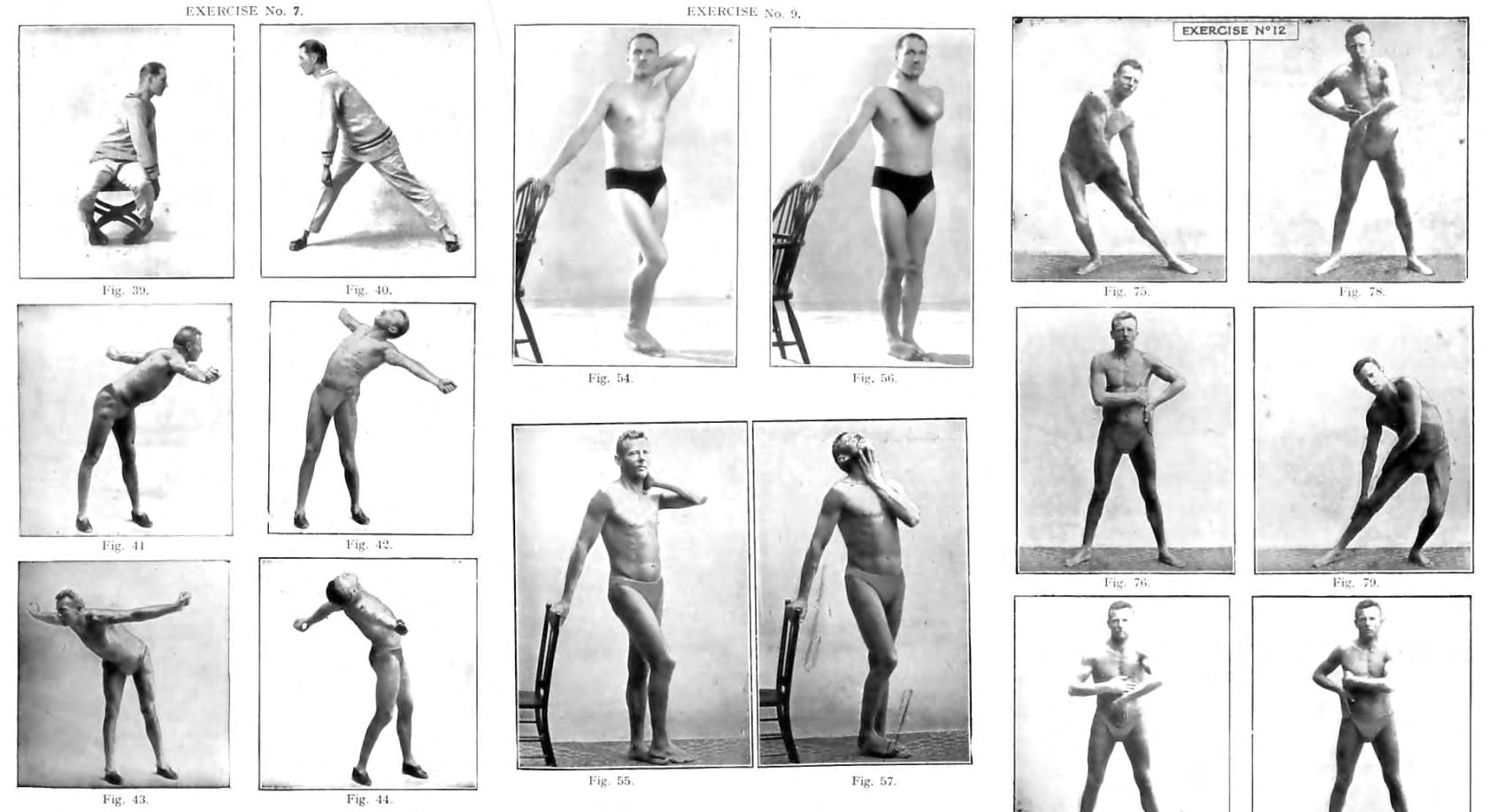
Spinal Warmups
During my travels by motorcycle, a chiropractor friend introduced me to the idea that, especially as we get older, the spine needs to be regularly flexed in all the ways it can be flexed, which are bending from front to back, bending from side to side, and twisting. If we don’t do this, the spine apparently dries up and becomes stiffer, and this results in all sorts of other health problems. He showed me some simple movements to flex my spine, and they did reliably make me feel better. The downside was that they had that somewhat boring, machine-like quality that made them feel like a chore.
Walking
I walked 900 miles from Delaware to Ohio, generally about 20-30 miles per day for four days a week. Once my feet stopped hurting and I got past counting the miles, I became immensely calm and creative and good at appreciating beauty. I wrote a lot of essays and poetry and even published a book of Turkish Sufi poetry translations. Not sure much more needs to be said here; I think walking is extremely healthy for the body and mind and also gentle enough to be sustainable into old age.
Yoga
I’ve never made a serious attempt at yoga; I’ve just done a few classes or routines here and there, generally accompanying some woman in my life. I do find that it generally makes me feel good, but I haven’t noticed anything special about it beyond other kinds of stretching. I used to roll around and stretch intuitively in whatever ways felt good, and called this “redneck yoga,” and that seemed to work about equally well for me. My other critique is that yoga tends to emphasize static poses, and like I mentioned in the section on stretching, I’m not sure that’s the best way to develop flexibility. On a more cultural note, yoga is supposedly ancient and Indian but in fact most of the poses were developed in modern times and the culture of modern yoga is unavoidably “well-off urban white girl” culture, which is why the idea of “redneck yoga” is funny. So I think part of the reason yoga never stuck for me is that this is not quite the kind of energy I want to be cultivating.
Convict Conditioning
Our friend Tasshin inspired my partner Alex and I to try the progressive bodyweight exercise system taught in Convict Conditioning, by Paul Wade. The idea is to do a set of six movements, each with many levels of difficulty from easy to nearly impossible. As you gain strength in each area, you move up to the next level, always doing a relatively small number of reps at a challenging difficulty. We found it to be effective at building strength slowly but surely in just 10-15 minutes every three days. We paused recently as I’ll explain later, but we’d like to start some kind of strength training again at some point. Leaning into toughness and fierceness has been good for Alex but the exercises do have a cultural signature, somewhat opposite to yoga, and I don’t really want to cultivate the energy of wary prisoners who need to be tough to survive.
HIIT
High intensity interval training (aka HIIT) is the practice of doing intense movements for brief intervals interspersed with intervals of rest. Alex and I came up with our own routine of three sets of four movements done over a period of about 13 minutes. If you’re doing it right it’s always somewhat unpleasant, because you should be pushing on your oxygen limit. I notice that the first set feels like it takes forever and then time seems to speed up and I’ll finish feeling invigorated. I like it—I mean I hate it but it works. I think a good choice of movements can make it work even better, for example if you can get some spinal bending and twisting in there that’s a bonus. It seemed to help boost Alex’s metabolism. Mine doesn’t need much boosting but I think it may have made my energy levels more consistent.
Wiggling
Recently I started experimenting with a type of movement where I rock or wiggle my whole body at a resonant frequency. The simplest version is lying flat on my back with my legs folded, hands on knees, gently pushing and pulling them at whatever speed gets the most motion for the least effort, which indicates a resonant frequency of the body. If I cross my arms, it becomes easy to push one knee while pulling the other, creating a side-to-side wiggling motion. My whole spine gets mobilized up to the base of my skull, and I find it extremely relaxing. Doing this made me think about the importance of coherence,2 and the idea that to work optimally our bodies need to be synchronized at many scales from molecules and cells all the way up to large structures like the spine and limbs. Maybe things like stress and sitting cause the body to divide into separate “compartments,” each with its own rhythm and all out of time with each other. Full-body rhythmic movement could be one way to get these parts moving as one again.
Qigong
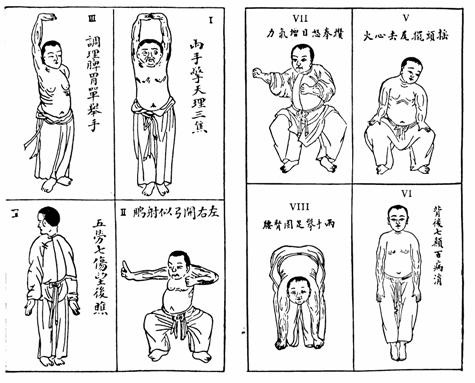
I had some wrist pain (really from emotional tension in my shoulder and back), which made it hard for me to do many of the bodyweight exercises that we were using for strength and HIIT. I also felt like the winter season called for something a bit different; it was more the time to build wisdom than to build muscle. So we switched to Qigong, following a video series by Lee Holden. Alex had kept coming back to two of his videos for ten years, and we both enjoyed his practical down-to-earth style. Qigong is a modern umbrella term gathering together practices from ancient Chinese shamanism, Taoism, traditional Chinese medicine, and martial arts. It’s typically done standing in place with the knees slightly bent, using repeated flowing movements coordinated with breathing, stretching, meditation, and attention to the presence and movement of qi—vital life force energy—which is subtle and mysterious but may correspond to bioelectricity in the modern scientific paradigm.
What I love about qigong is how much depth and subtlety there is in the movements compared to the practices under the “exercise” umbrella. For example, I can already do push-ups with perfect form, and so the only way to advance is to do more of them. Or I can make the push-ups harder by using my body less effectively, putting more strain on my muscles and making them work harder. But at some point, my push-up performance will peak and then steadily decline as I move toward death. In contrast, the form of a single qigong movement takes a lifetime to master, if it’s possible at all (not to mention that there are countless movements to master). The goal of qigong is to embody the deeply relaxed power of a cloud, a river, a tree, and so forth. One can always move more fluidly, the body and mind can always be more in tune, and there’s always a deeper level of relaxation and a stronger power. It’s a bit like making an invisible brush painting in the air; it has the infinite range and scope of art. This means that if I practice qigong for the rest of my life, I can always keep getting better at it; my best movement could easily be the one just before my death.
As an example of the kinds of lessons qigong is teaching me right now, I was noticing that some of the flows made my shoulders ache in the same sort of way that static isometric exercises would. If I were in an exercise mentality, I would “feel the burn” and “embrace the suck,” believing that “pain is weakness leaving the body” and “no pain, no gain.” But settling into the qigong mentality, I followed the teacher’s prompts to not try to move the energy but to allow the energy to move me. He evoked the image of being like bamboo: it’s not the bamboo that moves the wind but the wind that moves the bamboo. As I imagined the flow of energy moving my hands and arms like branches in the wind, they immediately felt like they were floating and my shoulders stopped hurting, and yet I was still doing the movement, and even more fluidly than before! The tightening of my shoulders was not only unnecessary, it had been holding me back. The lesson of the push-up is to make specific muscles stronger by using them less effectively, and the lesson of qigong is to make my body as a whole stronger by using it more effectively, with less wasted effort.
We’ve been practicing qigong two or three times a day: before breakfast, outside in the middle of a walk, and before bed. It’s reliably enjoyable to do and reliably leaves us feeling both relaxed and energized. And now that I’m in my 40s, I can also appreciate that it’s sustainable, something I’ll be able to do for the rest of my life, like the tens of millions of elderly people in China who practice it daily. Its breadth and depth means there will always be some aspect of it that keeps me engaged and growing. Instead of telling a story of the body being a machine that gradually breaks down, it tells a story of the body being an intricate flow of subtle and mysterious energies, connected to the cosmos and constantly growing in presence and wisdom.
Synthesis
After trying all these ways to move, I think I’m finally starting to understand what I’m looking for. It’s not about any particular system but about cultivating a particular spirit, and for me that spirit is the quiet but inexorable power and flow of wild nature. I’d like to keep energy flowing through me like a clear stream instead of letting it stagnate or leak out somewhere. I’d like to keep it flowing clearly even as it slows to a trickle and ultimately stops. I’d like to let it deepen and shape the channels it flows through, just as a natural stream shapes itself to move water gently and steadily toward the sea.
We tend to sort movements into categories like exercise, work, dance, and prayer, but in fact there’s nothing to stop us from, say, working in a prayerful way or dancing for exercise. In fact any of these types of movement can be done in almost any spirit, although some spirits may be more effective than others for a given task. I’d like to break it down differently and look at some of the many ways movement can affect the body and mind, so here’s a list of as many as I can think of right now:
Performance (strength and endurance): this is what exercise targets and what it does best. Strength and endurance are the same things you’d want from a tool or a machine, so it’s no surprise that going after them leads to body-as-machine type thinking. Developing strength seems to be mainly about signalling to the body that strength is needed and giving it time to build the required muscle. So the important thing is to push the body’s limits a bit and then give it time to rest and adapt. It doesn’t need to take very much time.
Range of motion: it’s good to be able to use our strength with some amount of flexibility, and lengthening muscles tends to require relaxing them, which is a side benefit of being flexible. There are many systems that target flexibility but I get the best results by repeatedly pushing slightly into my limits and backing off.
Relaxation: strength requires tensing muscles, but fluid movement and flexibility require relaxing them. If one’s “movement diet” has more tightening than loosening, it’s eventually going to lead to stiffness, pain, and stagnant fluids, so it’s important to practice releasing the tension as well.
Blood flow: vigorous movement causes the body to circulate more blood to supply tissues with enough oxygen. I’ve noticed that intense exercise is a good time to notice what parts of my body are feeling bad; the bad feelings indicate where I’m not getting enough oxygen, and mobilizing or relaxing these areas can restore their circulation, which presumably has wider benefits even when I’m not oxygen-starved.
Pumping lymph: the lymphatic system has no pump of its own, and relies on tissue movement to pump fluid through a series of one-way valves. Lymph bathes the cells, keeping them hydrated and carrying away waste to be filtered and processed. Stagnant lymph can cause all sorts of problems, but even gentle movement will move it, I imagine it being like water in an estuary pulsing gently with the tide.
Lubricating joints: the cartilage that allows our bones to glide against each other isn’t supplied with blood, so like the lymphatic system it relies on body movement to pump in nutrients and pump out waste products. Moving and squeezing the capsule of synovial fluid around the joint does this job.
Stretching the lungs: our lungs are also passive, and rely on muscular movements to pump air through them. The diaphragm pulls them down from the bottom, the ribs pull them out from the sides, and the upper chest pulls them up from the top. If we don’t breathe deeply every now and then, many of the air sacs in our lungs tend to stay collapsed and our breathing becomes less efficient. Intense exercise is a way to force us to breathe deeply, but we can also do it consciously as in pranayama, qigong, etc.
Breathing: breathing isn’t solely mechanical, it also seems to have profound effects on consciousness. For example box breathing is a proven technique for stress-reduction, and you can even get powerful psychedelic effects from hyperventilating like in holotropic breathwork. At the other end of the scale, intentional shallow breathing can be effective, as in Buteyko breathing. There’s probably a lot more to discover about breathing.
Growing bones: bones aren’t passive, they generate electrical charges when forces are applied to them, and they grow, strengthen, and solidify where forces are highest. Movement that loads the bones strengthens them. This is where lifting or carrying heavy things shines, but I think jumping is also good. Even something gentler like sleeping on a hard surface could be good for the bones.
Applying heat: emerging evidence suggests that almost all the water in the body is in a liquid-crystalline or quantum coherent state that forms next to membranes, gels, and proteins, and many functions of life probably rely on water being in this form. Energy is needed to create the organization, and it appears to come from light, in practice mainly light from the infrared part of the spectrum. This could explain why the heat radiated from the sun or a wood stove or a hot bath can feel so good, almost as if it’s a necessary nutrient. We can also generate our own internal heat with movement, by shivering, or by increasing our metabolic rate like when we have a fever.
Rocking and trembling: we know that rocking or bouncing babies is a good way to calm them, and other animals seem to recover from traumatic events by various forms of trembling and shaking, which inspired a therapy modality called TRE. Moving the eyes back and forth is the basis of another one called EMDR. It seems that gentle oscillating movements are generally calming, and we can get them from something as simple as the left-right alternation of walking.
Massaging internal organs: we don’t often think about the internal organs as a target for massage, but any movement that compresses and expands the trunk or presses on the relaxed belly can give them a gentle massage. I don’t know what the science says, but it feels good and that seems like a good sign.
Balance: inside our ears are chambers full of hairs and tiny stones called otoliths that let us know when we’re changing speed and which way is down. You could think of it like a hairy snow globe that gets shaken whenever our head tilts, speeds up, slows down, or moves in a new direction. We use this sensitive instrument to keep our balance, and movement that requires balancing helps to calibrate it.3 This gets especially important as we grow older and less able to recover from falls.
Proprioception: our muscles and joints include stretch-sensitive fibers and pressure sensitive neurons that help us know where we are in space, forming a sort of mental body image that we rely on to plan movements. Paying close attention to the body while moving helps calibrate this image and make it more coherent, timely, and accurate.
Meditation: when we think of meditation, we tend to think of sitting still and focusing on the breath, but it can also be done while moving. This is a massive subject which I won’t get into here, but consider that any form of conscious movement can be done in a meditative or mindful way, bringing the well-known benefits of those states.
Enjoyment!: this may actually be the most important factor of all. From a purely rational standpoint, the movement that you enjoy is the movement you’re most likely to do over and over again. If you don’t enjoy it, you’re more likely to skip it or give it up entirely. From a more spiritual perspective, I believe we get way more benefit from practices when we do them joyfully. Think of the scenario where you force yourself to exercise; you may feel better afterwards but it still involves an internal conflict in which one part of you has to lose for the other to win. It might make you stronger but at the expense of being less integrated and whole. Think of how you might easily digest a delicious family dinner, but the exact same meal might sit in your stomach like a stone if you were stressed out. The exercise mentality sees work as the only important ingredient and pain as a necessary side effect, but I’d like to take pleasure in movement as well. Let’s move more joyfully!
I’ve started to look at movements as being made up of some combination of these ingredients, or maybe I should say nutrients. I can ask: what is a given movement bringing me, and can it be made richer by adding something more? Almost anything can be enhanced by paying attention to the breath or by cultivating joy. Sometimes I’m keeping my spine straight for no good reason, or bending over when I could be squatting. I could even pick out a few of these ingredients and cook up something from scratch to highlight them. The possibilities are endless; there are billions of ways to do it.
It’s been a while but I believe my personal record on the mile was 5:22, and on the 5k it was 18:06. This was fast enough to place in local races, but not nearly fast enough to be competitive at the regional or state level. Funny how those numbers still stick in my head 25 years later.
I’m learning a lot about coherence from reading books by scientist Mae-Wan Ho. It’s probably a topic for another blog post, but first I’d like to get a better grasp on the phenomenon she calls “quantum jazz” where all the parts of a fully coherent system are moving as one but also have the maximum freedom to improvise. Think of a body as a community of cells, in which perfectly coordinated mutual support enables each cell to work (and play?) with maximum efficiency and effectiveness. Maybe individualism and collectivism aren’t as opposed as we’ve been taught, and there’s a secret third way.
The way the otoliths move through the inner ear depends on the viscosity of the fluid inside it, which is why our sense of balance is affected by alcohol (which makes it thinner), dehydration (which makes it thicker), and medications (which do who knows what). Even without disrupting balance, unexpected signals from the inner ear can cause nausea in the same way that seasickness does, which may be why all the factors above can also make us nauseous.
I love this so much, thank you Jesse!
Fascinating! Thanks for assembling. It's amazing what 40+ years of varied movement can produce. Ever try any social partner dancing?