
The Constant Conversation

The more I think about how psychic powers might work physically, the more they’ve started to feel real and present to me. Part of me might have been trying to reduce shared consciousness to something mechanical, but instead it seems I’ve been inviting it into my everyday experience. Soon after I published Part 1 about how telepathy might work, I got psychically involved with a noisy crew of Mexican rappers and a food truck chef, and I’m not still not sure what was going on but it felt very real. If you’re not interested in the sciencey stuff, you can skim to the section called “Give and Take” and read those stories, but first I’m going to expand on the different ways we might all be telepathic, and explore some of the questions that raises.
What we can learn from the skeptics
In Part 1 of this series, I used the viral podcast The Telepathy Tapes as a jumping-off point. But there’s another interpretation of what’s going on there that you should probably know about. In the show, non-speaking autistic people demonstrate their telepathic abilities by spelling out messages, either by pointing at letters or typing on a keyboard. There’s always a facilitator involved, who’s either holding their spelling device or at least in the room keeping them on task. Let’s call the facilitator Alice and the speller Bob. In all the telepathy tests shown on the show’s website, Bob is spelling something that only Alice should know, and this leaves room for a big objection.
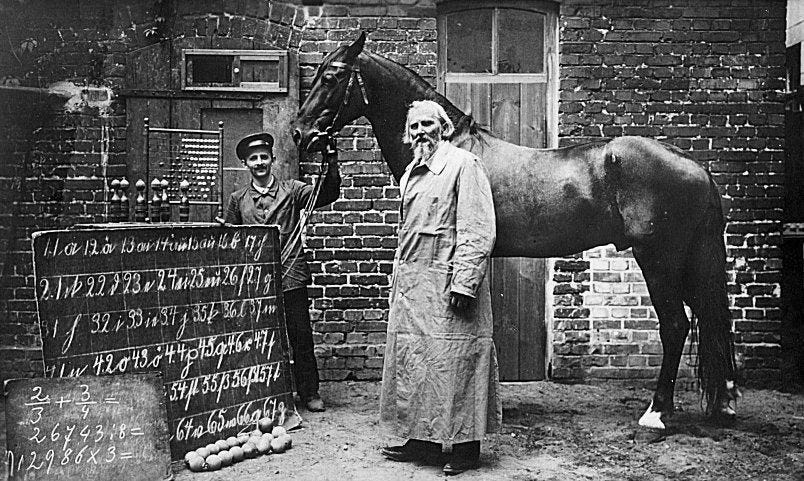
See, we’ve known for a long time that communication can happen in very subtle ways. In the early 1900s there was a famous horse named Clever Hans who seemed to be able to answer a wide variety of questions, including arithmetic problems, by tapping his foot a certain number of times. Of course this got scientists wondering what was really going on, and so a biologist named Oskar Pfungst was tasked with finding out. Through a series of experiments, he learned that Hans could only get the answer right if he could see a person who knew the answer. Pfungst theorized that Hans was observing subtle changes in posture or facial tension, and he even learned to do this himself, demonstrating “telepathy” by telling someone to think of a number and successfully tapping out the number in their mind while watching their face carefully. It turned out Hans was clever, not the kind of clever that solves arithmetic problems, but the kind of clever that solves communication problems.
So another interpretation of what’s going on with Alice and Bob is that Bob is really good at picking up on subtle signs from Alice, and he’s using that ability to spell out whatever she’s thinking. It’s likely neither of them is aware of this, just like Hans’s trainer was not aware that Hans was reading subtle signals from him. This is just something we animals do, because sensing tiny postural changes is an ancient and primal way of communicating.1 In fact it’s so subconscious and automatic that we can’t seem to stop ourselves from doing it. Pfungst was challenged to prove his theory about facial expressions by consciously controlling his own body so as to fool Hans into giving the wrong answer, but he was never able to do it.
This kind of unconscious communication has been named the “Clever Hans effect,” and it’s fairly hard to control for in psychology experiments.2 How can we be sure that researchers aren’t subconsciously influencing subjects, or that subjects aren’t subconsciously influencing each other? I was curious to know whether this effect could explain some of what’s going on in The Telepathy Tapes, so I paid $10 to get access to their videos of testing sessions. I was disappointed to find that none of the tests in the videos attempted to control for the Clever Hans effect. In some, the speller was blindfolded, but the facilitator was touching them. In others, the speller was pointing at a board that the facilitator was holding in the air, an excellent magnifier for the unconscious movements called ideomotor responses. The most compelling test shows the facilitator standing across the room from the speller, but unfortunately she makes an utterance between every letter.3 The only video that thoroughly controlled for the Clever Hans effect was actually of a parrot talking about what his human friend was seeing in a room 55 feet away with the door shut.4
On the extreme end, some skeptics believe that autistic spellers are in fact just behaving as human ouija boards, not spelling their own thoughts but only spelling what their facilitators subconsciously want them to. These skeptics came up with an experiment called an “authorship test” where Bob tries to spell the name of an object that he can see but his facilitator Alice can’t. If Bob is spelling his own thoughts, this should be easy, but if he’s spelling Alice’s thoughts, it should be impossible. According to the skeptics, so far no speller has been able to pass their authorship tests.5 If you want to read a good overview of the skeptical case, this an excellent article. My guess is that neither the extreme skeptics nor the extreme believers are entirely right, but there’s not enough publicly available evidence for me to feel certain of anything. The reason I based my last post on a future telepathy test from inside a Faraday cage is that it would be extremely interesting if it was successful, but we can’t know yet how it’s going to turn out.
The sea of sensation
But wait, isn’t what Clever Hans could do still kind of remarkable? On the one hand, we could write it off as “just” another kind of communication, but it’s intriguing that not only was it involuntary on the human’s part, but even a very clever and dedicated human wasn’t able to figure out how to lie to Hans. Unlike communication by talking or writing, the human wasn’t trying to say anything. Sure, the information is passed from human to horse through patterns of visible light, but does that mean it shouldn’t count as mind reading? Is it only mind reading if it uses some “sixth sense” that science hasn’t located?
Well, here’s an illustration of the information we get from the conventional five senses:
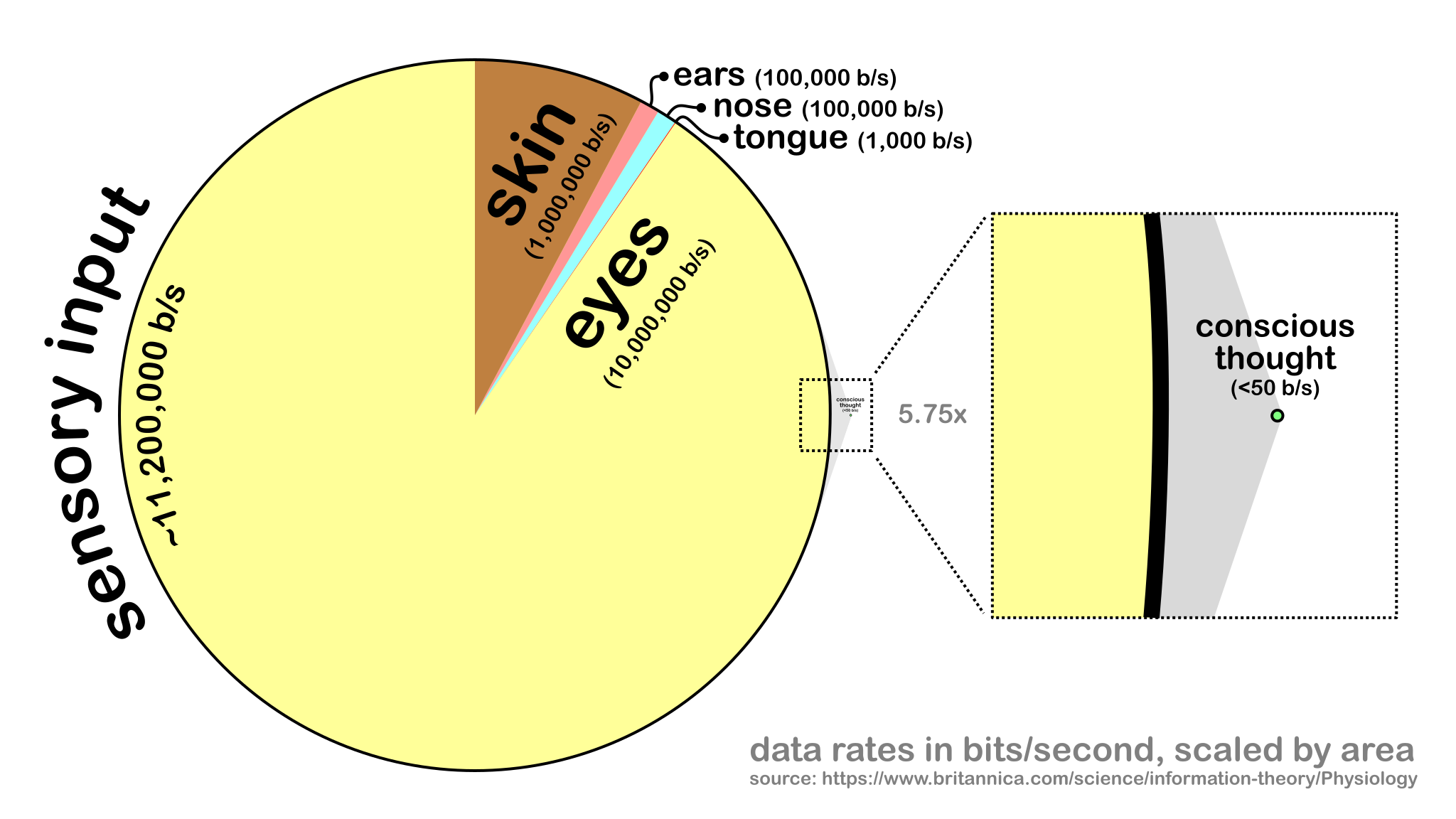
Making this graphic shifted something for me. The area of the big circle represents the approximately 11,201,000 bits per second of information coming into the brain from the conventional sense organs.6 To the right of it you can see a tiny circle representing the speed of conscious verbal thought. The difference in scale is staggering! If you try to describe your moment-to-moment experience in words, somehow all of that rich sensory information needs to be combined, remixed, and compressed down to fit the bandwidth of verbal thought. Somehow 99.9995% of it needs to be ignored or discarded or combined with other parts, and every single person is going to have a different way of doing this.
The fact that you understand these words, the fact that we can communicate with each other at all suggests there’s a good amount of overlap between the 0.0005% that you and I have learned to hold onto.7 There must be some commonality in how we filter our senses, because otherwise we wouldn’t be able to communicate, but there must also be some differences, because otherwise we would all think and feel and act the same. If I imagine my mind as an intricate information funnel that condenses all the lights, touches, temperatures, vibrations, smells, and tastes that surround me into ideas about the world, it becomes clear that who I am and the world I appear to live in are defined by what my mind is paying attention to. I am the precise quality of my attention. My mind distills the sea of sensation into a steady drip of consciousness. The part of the sea I draw sensations from and the exact process of distillation gives my consciousness its distinctive flavor.
Let’s get back to Clever Hans. His attention must have had a different quality from ours because he was a horse: he felt horse sensations and distilled them with a horse consciousness. Horses can’t see in color but they have a sharp eye for shapes and are very sensitive to motion; in the wild this is what lets them avoid predators and move as a herd. Their language, discovered and named “equus” by pioneering horse trainer Monty Roberts, is almost entirely visual and based on tiny details of posture. So when Clever Hans performed, while the human audience was mostly paying attention to the words of the question and the taps of his foot, Hans, who could not really understand German, was directing most of his attention to his handler’s body:
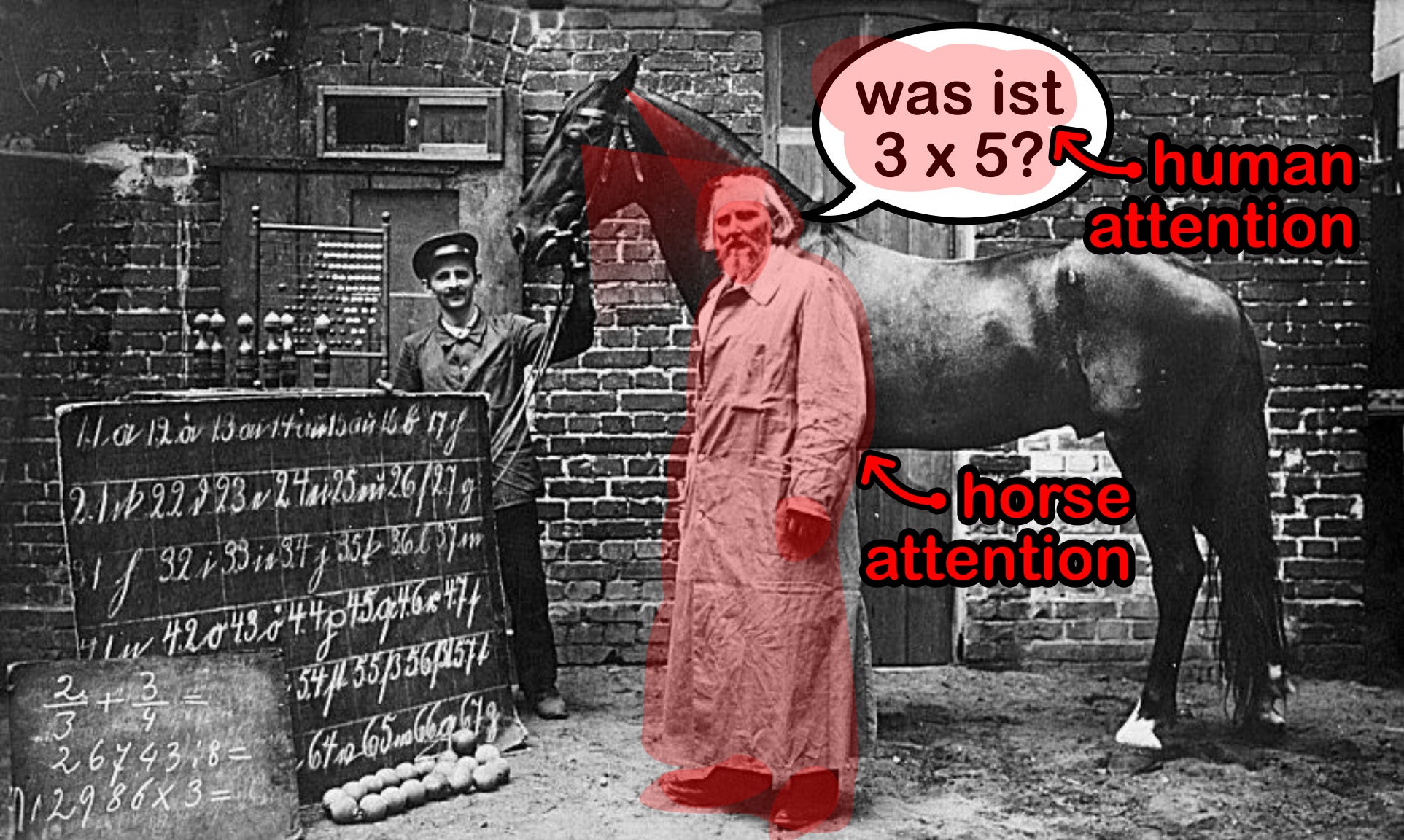
Oskar Pfungst, the scientist who studied Hans, discovered that it was possible to shape his own attention to be a little more horselike, gaining the ability to do the same kinds of things that Hans could. But he still couldn’t fool Hans by controlling what he was saying with his own body language.8 Every one of us is broadcasting all kinds of signals all the time whether we intend to or not but, like the audience watching Clever Hans, we often pay so much attention to words that we ignore everything else, which makes this type of mind-reading seem miraculous. And it is miraculous! But it’s not out of reach: all it takes is changing our minds about what kinds of details are important, shifting our attention to different aspects of what we’re perceiving, and knowing things that we couldn’t have known before.
The sea of sensation gets deeper
Many people have psychic experiences—please feel free to post yours in the comments. We can write them off as chance or coincidence, and many choose to, but what could we learn from taking them seriously? Wordless communication with someone we can see, hear, or touch? Well, we can explain that with special attention to the senses, like we’ve been talking about. But what about when this happens when we can’t see, hear or touch, like the sensation of being watched from behind, or the case of the parrot sensing things from a room 55 feet away with the door closed? I believe this could be explained using electromagnetic phenomena. It’s an open question whether humans can sense magnetic fields, but we definitely have the biological equipment to do it, and some people have a robust sense of direction built into their language.9 We can also feel static charges through the movement of our fine body hairs, and I’m sure there are more sensory paths that haven’t been described yet. This is still paying special attention to our senses, but going beyond the conventional five.
What about when people feel premonitions from a much longer distance, like the intuition that something terrible has happened to a loved one on the other side of the world? I believe this is probably not electromagnetic. Shortwave radios can communicate over these kind of distances by bouncing signals off the ionosphere, but it takes a lot of energy to make a signal that strong.10 I think the explanation is more likely to be something akin to the spatial entanglement I talked about in Part 1. We could see this as yet another kind of sense, stranger than the ones we usually think about, but just as real. Putting this all together, the amount of sensory information we’re receiving is probably much bigger than the illustration of the five conventional senses. We’re awash in all kinds of information in all kinds of forms, coming from nearby and far away, and the quality of our attention shapes which parts of it enter our conscious awareness.
And what about subconscious awareness? Our bodies do so much that we’re mostly not conscious of, like breathing, digestion, pumping blood, repairing tissues, and walking. The human gut has its own intrinsic nervous system, with about the same number of neurons as a hamster. Our hearts also have one, with about the same number of neurons as an insect. When we talk about gut instincts, or feeling something in our hearts, this could be very literal. Don’t be fooled by the tiny circle labelled “conscious thought” in the illustration above; parts of us are constantly observing different aspects of our sensory input to keep us healthy and safe and connected to others. Their conclusions bubble up from the subconscious depths in the form of emotions, intuitions, and dreams, affecting our bodies before we notice them consciously. Most of us don’t know how to sense what number someone else is thinking of, but we can be influenced by their mood without even trying.
So I’ve been thinking about this a lot. If subconscious communication is involuntary and ever-present, it calls into question a lot of my beliefs about being a separate individual. If I’m sitting alone in a hotel room, am I really alone? Could the inexplicable little ups and downs of my emotional life be influenced by the people in neighboring rooms? When I walk around by myself, am I ever really alone? Even in the wilderness I’m surrounded by living beings, and the kind of thoughts I would have on a mountaintop are very different from the ones I would have in a swamp. If I’m in the city, it matters what city I’m in. I feel like I’m a different person in Konya than I am in Berlin; is that because I’m resonating with two very different psychic environments? Local cultures get expressed in so many forms: architecture, body language, graffiti, food, maybe even subtle patterns of electromagnetic radiation. If who I am depends on where I am, where’s the boundary between mountains, swamps, cities, and me? Is there a boundary?
Atomized society tells us that the human default is to be separate, and we have to work for connection, but what if it’s the exact opposite? What if we’re connected by default, and we have to work to be separate?
Give and take
This winter Alex and I have been spending a month in Guadalajara, Mexico, a place that feels like spring all year round. But it’s not just the weather we came for, it’s the vibes. I first came here in 2022 and wrote about how the city makes 60km (37 miles) of major roads pedestrian-only every Sunday, the entrepreneurial vibrancy of the market culture, and a zillion little things that just make me feel good. It’s a rare city that seems genuinely alive, and where I don’t feel the need to shield myself from harsh energy because most of the people are not projecting harsh energy. Even the fruits and vegetables seem especially benevolent and nourishing. Here, the sea of sensation feels like a warm bath.
But sometimes there are exceptions. A group of Mexican rappers came to stay at our hostel for two nights, three young men channeling primal chaotic energy. They seemed to be recording some tracks in their room across the courtyard, and at first I didn’t pay them much mind. Since the weather is always good here, there’s no insulation or air conditioning to speak of, only open vents, and that means there’s no escaping from noise. On their first night, the rappers came in drunk and making a racket. It was late and we were trying to sleep, so in a relaxed half-conscious state, I wondered if I might be able to use psychic powers to quiet them down and put them to bed. I intuitively reached out a sleepy calming presence with my mind, and sure enough, two of the three guys stopped talking within a minute or so.
But the other one, the lead singer, kept on talking; he was louder and maybe putting up more resistance. Intuitively, I imagined a calmness like a giant sheet of paper, pushing it up, up, up, and finally tipping it so it would fall gently over the guys in the other room. Immediately it got totally quiet and we went to sleep. Now, I can’t really know if it was me quieting them down or just a coincidence, but the experience got me thinking about how I relate to the world. Up to that point, I’d mostly seen myself as a passive receiver: if someone was being annoying, I would either leave or put in earplugs and try to tune them out. But what if I could take a more active role? What if I could improve the world around me? Those young guys might not recognize the value of a good night’s sleep, and yet they might have felt better the next morning than they would have if I left them to their own devices.
The next night presented a harder challenge. Instead of going out, it appeared they were recording some tracks in their room. At one point I heard a man chastising them, but this only seemed to make the lead singer angrier. After the man left it seemed like the singer was cursing him, although all I could catch was “puto! puto! puto!” I drifted off into uneasy sleep and then woke up around 2:30am. Alex hadn’t slept at all; she felt threatened. And there was something threatening about the energy that these guys were putting out,. I didn’t feel in any physical danger but the guy’s voice was harsh and piercing. He was trying to get something across with his music and it was working, but that thing felt ominous and oppressive. Intuitively I expanded a bubble of protection around the two of us, and I could feel Alex relaxing immediately. When I tried to expand the bubble to the size of our room, it felt difficult and I knew I wouldn’t be able to sleep while holding it. We talked and decided to just leave and go to a hotel across the street.
The hotel was fancier than our hostel, and quiet, but the room was unventilated and the windows wouldn’t open. Lying in the overly soft bed, breathing the stale air, and trying to get to sleep, I could feel something like long sticky strands of tar stretching from me back across the street. It felt like I’d tried to fight with the rappers and in doing so I had bound myself to them. I tried to cut the connection but it just snapped back. Then I remembered how Alex had said their energy felt “demonic” and that I’d read somewhere that the best way to deal with demons was to send them love. I projected loving-kindness toward the rappers, the sticky strands dissolved, and I fell asleep.
All of this happened in the intuitive and uncritical mindset of half-sleep. The next morning I tried to make sense of the experience from a waking state of mind. It seemed like I was able to alter the energy around me, but my motivations were really important. On the first night, my projection of calm came from a place of benevolence: I felt it would be better for everyone if everyone got to sleep. But the second night, the man scolding the rappers had been antagonistic, the rappers had responded with anger, and I had picked that up and responded with more annoyance and antagonism. If my actions on the second night had any effect at all, it was only to increase the aggression. You could say I’d allowed myself to be possessed by their demon and lost my ability to resolve things for everyone’s benefit. All of these dynamics would have worked the same way if I’d gone and talked to the guys, it’s just that our conversation, if we had one, was not in Spanish or any other spoken language.
If I were better at loving-kindness, I believe I could have done a better job, but that would take a lot of practice. Luckily for our sleep schedule, they checked out and I didn’t have to try again.
A few weeks later, we took a side trip to Sayulita to see the migrating humpback whales. On our first night there, we decided to get dinner at a Lebanese food truck for a change of pace, and while we were waiting for our order, I noticed that the food truck chef was in a foul mood. At first, I wished we had picked somewhere else to eat, because I believe food prepared by someone in a bad mood transmits some of that energy to the eater. At the very least it doesn’t taste as good. But then I remembered that I wasn’t just a passive part of the scene. I closed my eyes and tried to feel the chef’s bad mood, and soon it was like a fountain of gunk flowing into the top of my head, which I discharged through my legs and feet into the ground. At some point, it felt like the flow wanted to reverse, so I let it, and now it felt like a fountain of clear and pleasant energy was arcing from my head into his. I took peeks at him and it did seem like his mood was gradually clearing. By the time he handed us our food he was smiling and so was I. Lo and behold, the food tasted fantastic!
My friend Tricia says that everyone is doing energy work all the time, we just don’t all realize it. This idea appealed to me when I first heard it, and now I’m starting to feel it on a more visceral level. There’s a constant conversation going on that I can’t avoid being a part of. But I’m not just doomed to listen or leave, I can say things, and if my intentions are good, the things I say can leave everyone better off. Realizing this is a little scary for me, but also exciting. To feel in my bones like I’m part of something bigger expands the fullness of who I am. I just started reading The Spell of the Sensuous, which makes the case that this conversation can and should include the non-human world as well, that trees and birds and insects have voices, even rocks and rivers. I’ll have to leave that idea for Part 3, but for the moment I’m excited to practice listening and speaking in ways that are new to me, but old as life itself.

Reading these hidden signals is really just taking advantage of all the available information. The signals only seem “hidden” because they’re not obvious to the conscious mind of a typical modern human. This behavior is so universal that even artificial intelligence does it, the apparent strangeness only comes from believing that the perspective of a typical modern human is the most valid one.
Especially with human-animal communication experiments, the animal needs to have a reason to communicate in the first place. To rule out the Clever Hans effect, it would be best to not have any human in the room to influence the animal being studied, but communication is a fundamentally social act that’s hard to separate from a social context. Why would an animal say anything important if there wasn’t anyone there to say it to?
Even tiny changes in the amount of silence between words can be used to communicate, as demonstrated by famous mentalists like the Zancigs and the Piddingtons. The Zancigs had to practice for many hours a day to keep their skills sharp, but they also needed to be able to communicate a very large vocabulary, since their main act involved Agnes describing a personal item that Julius borrowed from a member of the audience. Sending letters and numbers would be a much easier skill to develop unconsciously.
If you want to see tests with the telepathic parrot you can watch this video on YouTube. Keep in mind that this video is edited to show only the hits, and that formally interpreting this as telepathy requires some statistical methodology and assumptions which you can read about here. That article also describes some of the events that led the parrot’s human caretaker to think he might have telepathic abilities.
If psychic powers are real, we also have to consider the possibility that a skeptical observer is capable of affecting the experiment by disrupting the psychic effects in some way. This would mean that believers would see results but skeptics would be unable to reproduce them. If that’s the world we live in, you can see how difficult it would be to prove anything to skeptics except what they already believe.
Note that this isn’t even all the known senses, for example we have proprioception telling us the precise position of our bodies and interoception telling us things about our blood pressure and chemistry, our digestive processes, the fullness of our stomach and bladder, etc. And there may be other senses we haven’t discovered yet; we’re discovering new structures in the body all the time. Anatomy is hard.
I’m simplifying a LOT here, because most of human cognition, the stuff that allows us to walk and cook and eat and digest our food, is operating at a subconscious level, processing the massive stream of sensory information at an earlier stage when it hasn’t been filtered down quite as much. It has to be this way, otherwise the fastest reaction time we could manage would be the half second it takes for sensory data to enter conscious awareness. If everything had to be managed by the conscious mind, we couldn’t react quickly enough to walk or even stand. Still, there must be a lot of compression even for unconscious cognition.
If it were easy to lie to a horse using body language, predators would have long since figured out how to do it, infiltrating the herd and killing at will. Animal communication is the product of a billion year arms race; it’s very primal and robust but far from simple.
The Kuuk Thaayorre language uses absolute direction instead of relative direction. For example, a speaker might say someone is “on my north” rather than “on my left” as we might, which means the speaker has to know that they’re facing east! Speakers do in fact have an unusually good sense of direction, and this is thought to support the Sapir-Whorf Hypothesis, which says that language shapes what concepts we’re able to think about. I think a more accurate description might be that language influences what sensations we treat as important or unimportant. It doesn’t constrain our abilities so much as shape the funnels we use to distill raw sensation. Young speakers of Kuuk Thaayorre would learn to pay attention to their own sensations of the earth’s magnetic field by associating them with how the people around them spoke.
In optimal atmospheric conditions, an amateur transmitter can communicate between continents using only 100 watts. But this is about equal to the entire energy consumption of the human body at rest, and most of that energy is being used for other tasks. That said, it’s possible biology has discovered a more efficient way to do things than technology.
Really beautiful, friend! “I am not a passive receiver” hit as i read it. My 2022 year of loving kindness meditation had odd synchronicities and data i couldn’t quite make sense of at the time. What you said about the rappers & cook ring true
Wow great magic! It is real after all!!!!